

Why Prime?
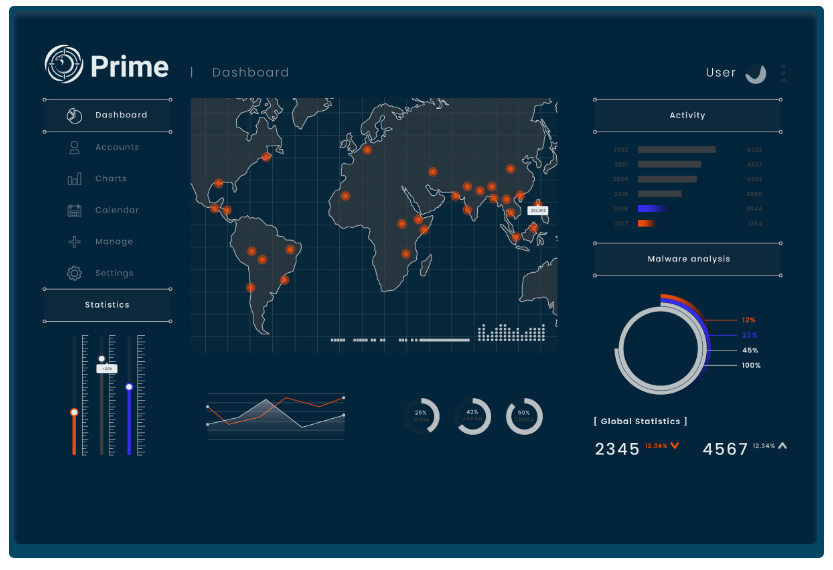
Prime is a SaaS-based Risk Intelligence Platform offering pre-emptive cyber threat detection, real-time insights, and threat landscape monitoring — powered by AI & ML.
Comprehensive Threat Visibility
Prime actively monitors threat activity across the Dark Web, Deep Web, Surface Web, Telegram, and underground breach forums. This multi-layered coverage ensures that organizations using Prime never miss a threat that could compromise their digital ecosystem.
Strategic & Tactical Insights
Prime delivers both executive-level strategic intel and detailed tactical reports — including TTPs, IOCs, and threat actor profiling.
STIX/TAXII Integration
Prime uses industry-standard STIX 2.1 and TAXII 2.1 protocols to share structured cyber threat intelligence.
Enterprise-Ready Architecture
Prime is engineered for scale. It is built to handle thousands of IOCs per day, supports multi-user role management, and provides enterprise-grade SLA support.

Latest Intelligence Reports
Our comprehensive threat intelligence reports provide critical insights on the latest cybersecurity threats and vulnerabilities.

Threat Intelligence Report on Bank of Baroda Data Breach
The emergence of a large-scale alleged data exposure involving Bank of Baroda has raised significant concerns regarding the potential compromise of customer information and internal banking records. Between 25 and 27 July 2026, a threat actor operating under the name "TripleX" published a listing on its Tor-hosted leak portal claiming possession of approximately 1 terabyte (TB) of data purportedly belonging to the bank. The listing advertises unrestricted public access to the alleged dataset and is accompanied by multiple sample documents, apparently intended to demonstrate the authenticity of the claimed breach.
August 6, 2026

Cyber Attacks on India Post the Attack in Pahalgam
Following the Pahalgam terrorist attack, India witnessed a sharp rise in cyberattacks. These attacks were targeted against sectors like the government, defence and BFSI. Despite a ceasefire being announced on 10 May, hostilities in cyberspace intensified. This multi-volume report analyses the threat actors, their coordinated attacks, resultant data leaks, and the formation of new threat alliances, and highlights the significant risks they pose for national security and public trust.
July 25, 2025
Browse by Category
- Advisory
- Cyber Attacks
- Malware
- Miscellaneous
- Threat Actors
- Zero Day Vulnerability

PHP Security Alert Critical Vulnerabilities and Recommended Actions
PHP2Shell has emerged as a serious security concern for organisations running internet-facing PHP applications. Security updates for the two vulnerabilities were released on 21 October 2026. However, reported threat intelligence indicates that exploitation attempts may have started as early as 17 October, several days before public disclosure. This means organisations should not limit their investigation to activity observed after the patches were released.
October 27, 2026

Threat Intelligence Advisory Report Analysis of the eMudhra Intermediate CA Private-Key Compromise
A security researcher has discovered that, on 17 October 2026, private keys of eight eMudhra intermediate Certification Authority (CA) certificates were vulnerable because they could be recovered from the corresponding public certificates. Each private scalar was an integer below 256, instead of a legitimate cryptographically unpredictable scalar, and the keys used the NIST P384 elliptic curve. This made the private keys recoverable in milliseconds and affected the public trust in the affected certification chains.
October 27, 2026

Technical Advisory-Interlock Ransomware – Initial Access, TTPs & Indicators of Compromise
This advisory, prepared by Athenian Tech, presents a technical and tactical analysis of Interlock Ransomware, an emerging cyber threat targeting virtual environments and exploiting social engineering vectors. The report provides a detailed breakdown of Interlock’s behavior, known indicators of compromise (IoCs), and command-and-control infrastructure, with specific relevance to organizations utilizing VPN technologies such as Cisco AnyConnect. Drawing from recent threat intelligence and MITRE ATT&CK mapping, this report aims to support defenders in identifying, mitigating, and responding to Interlock-related threats effectively.
September 15, 2026

Technical Advisory Report Vulnerabilities in Microsoft SQL Server and Newtonsoft.Json
On September 16, 2025, Google released an emergency update to address CVE-2025-10585, a high-severity zero-day vulnerability in its Chrome browser that is being actively exploited in the wild. This flaw, found in the V8 JavaScript and WebAssembly engine, allows attackers to trigger type confusion, resulting in memory corruption and arbitrary code execution (RCE).
September 15, 2026

Technical Advisory Report on Windows Kernel Elevation of Privilege Vulnerability (CVE-2025-62215)
A serious Elevation of Privilege (EoP) vulnerability, known as CVE-2025-62215, has been discovered in the Windows Kernel, allowing a locally authenticated attacker to escalate privileges to SYSTEM on affected Windows systems. Microsoft classified the flaw as Important and assigned it a CVSS score of 7.0, while CERT-In (CIAD-2025-0043) issued a national advisory warning that the vulnerability is being actively exploited in the wild.
September 15, 2026
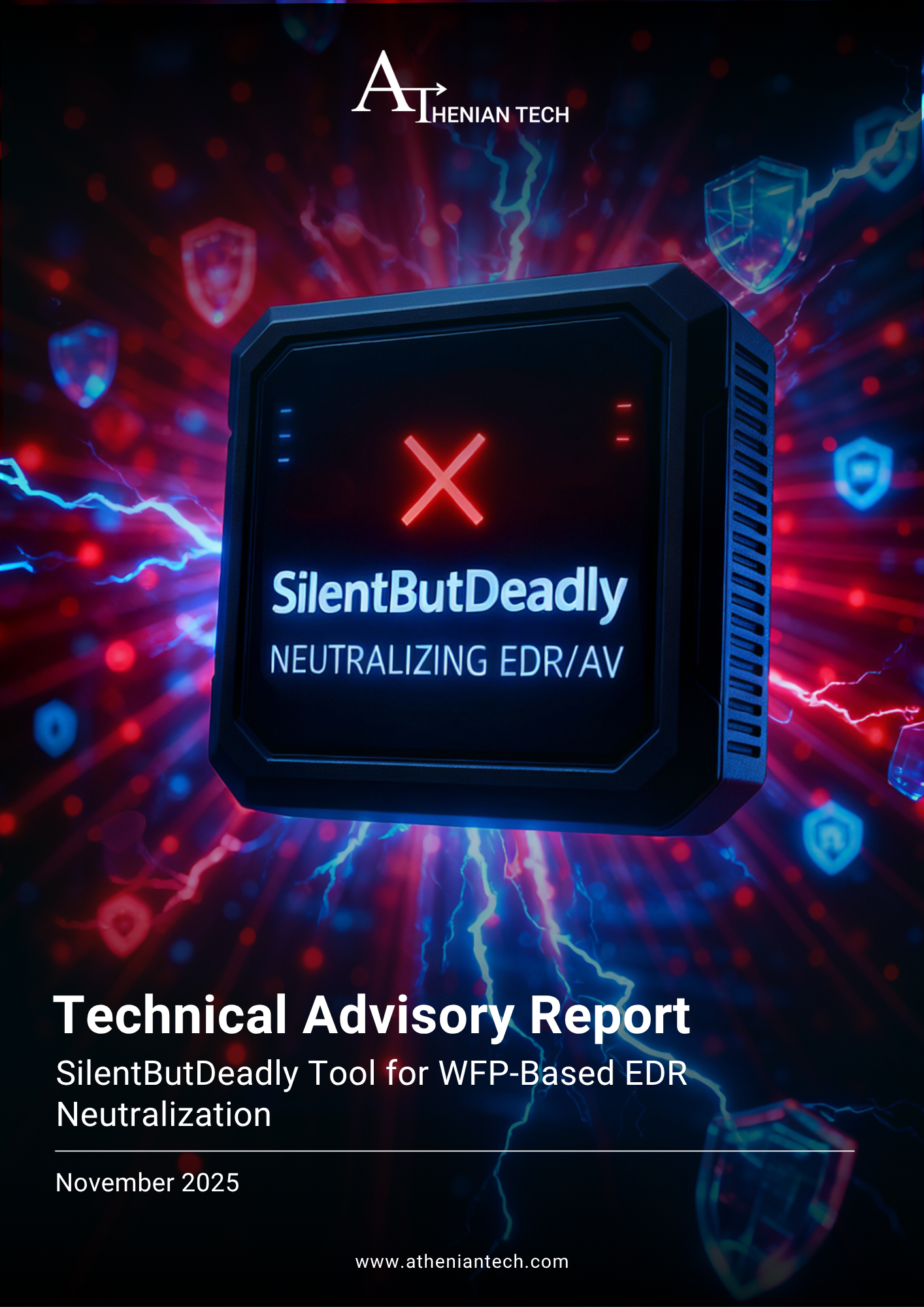
Technical Advisory Report on SilentButDeadly Tool for WFP-Based EDR Neutralization
A new category of endpoint security evasion techniques has appeared with the release of SilentButDeadly, an open-source tool designed to selectively disable Endpoint Detection & Response (EDR) and antivirus (AV) products without stopping their processes. By exploiting the Windows Filtering Platform (WFP), the tool quietly blocks inbound and outbound network communication for targeted security agents, effectively isolating them from their cloud backends while allowing the local process to keep running. This causes a stealthy decline in detection, telemetry, and response capabilities, enabling adversaries to operate with a lower chance of detection.
September 15, 2026